Saturday, 7 June 2014

Game Review of the Week: Nightmare in the Dark

Review by ThoRn (@RetroGameRevival)

Developer:   AM Factory            
Publisher:   Gavaking / Eleven     
Distributor: SNK                   
Platform:    NEO GEO MVS           
Release date:2000                  
Genre:       Platform/Puzzle/Action
Mode:        Single-player 2-player
Size:        166 Meg Cart          

Some games are fun because they immerse you in to a realm of the unknown and the unbelievable.  They can transport you to a place that is impossible to reach until you enter that virtual world.  You can become whoever you want, whenever you want.  And sometimes these games can take you to such a place with the simplest of concepts and mechanics.  Welcome to the graveyard of 'Nightmare in the Dark'....

BACKGROUND
…..  This was an ancient story.  When people still believed in the power of witchcraft.  There lived one gravedigger at a very small village in a remote region. He lived a quiet, solitary life in a corner of the cemetery. He kept away from the village people due to his very ugly appearance. One day, he found the graves were ransacked and some corpses were stolen. He didn't want the village people to find out, so he decided to eliminate the grave burglars by himself. Thus, he patrolled the cemetery every night. (Extracted from game introduction)


GAMEPLAY
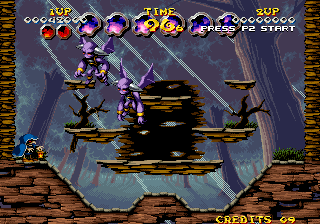
Nightmare in the Dark (NitD) is a horror puzzle/action/platform game released in 2000 by SNK for the Neo Geo MVS, but was never released for the home AES system.  The moment you start playing you will be reminded of Bubble Bobble and Snow Bros but with a much darker tone . 

Your job is to eliminate all the zombies, ghosts & ghouls from each graveyard whilst trying to avoid getting hit.  Your weapon of choice is a small fire you throw which is powered by your trusty lantern.  Throughout each level you will receive potion power ups which increase your characters speed, your fire power and your throw distance.  Once you hit an enemy with your first shot it will freeze them for a short period, you then need to keep firing away until the enemy turns in to a giant fireball which you can pick up and throw at the remainder of your enemies.  If you’re feeling lucky once you have created and picked up your enemy fireball you can try and navigate your way to the top of the board and unleash it to create a chain reaction which can ultimately eliminate every enemy currently on the screen and give you a little score bonus at the same time.


There are a total of 5 different non scrolling boards each with 5 stages.  Now that may not seem like much, but setting yourself the goal for a ‘1 Credit Clear’ will definitely be a challenge.  On the last board of each level you will be greeted by a boss who won’t make things easy for you.  Each boss you confront will unleash a swarm of minions on you so whilst you’re attacking the minions trying to create your fireball you will also be given the task of avoiding the boss attacks until you can get enough fireballs away on the boss to defeat it.


When you have killed all the enemies and destroyed the boss you will be showered with Treasure Chests, Diamonds and Potions.  Although most of the goodies you receive are for points purposes only, that is where half the fun lies as this game is very addictive and keeps you coming back for more, each time trying to beat your old high score.

There is 99 second limit and even though most of the time that will be more than enough to complete each stage, when you come to the boss you will definitely be tested to complete the board in that designated time frame.  If the counter does run down to zero, you wont die straight away but instead your skills will be tested even further when a large pumpkin head enters the board and has only has one purpose, to follow you wherever you go until it catches you.  This is a one hit, one kill game and only three lives until game over, so if you are limited to only a few credits you will definitely need to utilise your platform logic and hand-eye coordination skills.

CONTROLS
The controls are simple and responsive, the perfect combination for any good quality arcade game.  Some may say your character might be a little floaty when you jump, but it certainly does not take away from the game control.  And once you have received a few speed power ups, you will have great manoeuvrability wherever you are.


GRAPHICS
NitD has beautifully crafted  2D sprites and the backgrounds are just great pieces of art.  I actually found myself skipping the loot collection at the end of some of the levels just so I had a bit of time to take in the backgrounds.  Everything is coloured really well whilst still being able to maintain the dark and dreary atmosphere.  When a boss comes out to play that’s when you are treated to some great sprite creation and animation.  The detail and movement of some of the enemies and bosses are very reminiscent of the Metal Slug series.  Considering this is a non scrolling game, it’s amazing how much detail has still gone in to make it very pleasing on the eye.


SOUND
The music and sound effects fit in the game well.  Not all the music has a horror feel to it, some of it has this ‘funk’ sound but still fits in to the game play very well.  It’s not going to win any awards, but it’s all you need to help keep you focused on the task at hand.


OVERALL
Fun comes in many different shapes and sizes, and this little gem is definitely big fun in a simple package.  It offers a wide variety of challenges whilst keeping things straight forward.  Unfortunately it can be one of the more difficult MVS carts to find as it was one of the last games released before SNK fell to bankruptcy and only a limited run were produced.  It can be found on a few of the on line virtual console sites (not emulation downloads) but for any Neo Geo enthusiast, this is definitely one to have either in your collection or on the wish list.

VERDICT
7.5 out of 10

Monday, 2 June 2014

Game of the month June 2014: Super Off-Road

The winner of the vote for game of the month June 2014 is Ivan 'Ironman' Stewart's Super Off-Road for the Sega Mega Drive / Genesis - or the SNES if you are so inclined.

Released: 1992 (EU), 1993 (US)
Developer: Software Creations
Publisher: Ballistic

This game, who started out as an arcade game in 1989, was ported to a massive amount of computer systems and consoles. This time around we will be looking at the 16-bit releases on Sega and Nintendo's consoles, but if you are curious about how the game looks on other platforms, do check out this awesome video that compares 14 different versions of the game.


In the game you race these tiny trucks around a tracks that can be viewed entirely on a single screen, i.e. without the use of scrolling. That you have complete knowledge of the track doesn't make the game any less challenging though, as you will soon find out once you start jumping, sliding, and nitro boosting your way through this little gem of a racing game. It's very important to make sure you hit the right jumps, avoid the hazards, whilst staying clear of the opponents trucks - something that can be quite taxing. 

Doing a quick search on Ebay it seems that this is a fairly cheap game to pick up, and you will probably have to get your hands on a cartridge seeing as the game hasn't been released on the Virtual Console.

As always, if you are considering playing along with us, please visit the forums at http://retrogamesquad.com/community/ and join in on the discussion.

Saturday, 31 May 2014

Retro Review of the Week: Looney Tunes Collector: Alert!


Looney Tunes Collector: Alert!
 
Platform: Gameboy Color
Release: 2000
Developer: Infogrames Lyon
Publisher: Infogrames

Designer:  Vanna Ty
Animator:  Lionel Frappé
Graphics: Josiane Girard
Programmers:  Séphane Abrassart, Laurent Krzywanski, Alexander Bacquart, Sébastien Charvet, Florent Curé
Composer: Alberto José González

In June 2000 the handheld game market was still clearly dominated by only one player: Nintendo.  The Gameboy Color had brought new life to the aging Gameboy handheld market and the true successor, the GBA was still a year away from North American shelves, with competitors like the Neo Geo Pocket and cellphones making little to no impression. 

With hardware limitations in the age of 3D graphics on consoles making development of new ideas harder and harder on the handheld, a slew of clones of successful games were hitting the market, and nothing was more successful than the all-powerful Pokemon franchise.  Looney Tunes Collector: Alert! (aka Looney Tunes Collector: Martian Quest in Japan, Attacke von Mars in Germany, Gevaar van Mars in Holland and Martian Alert elsewhere in Europe) was originally perceived to be just another Pokemon retread with a famous license thrown on top, and if you heard the pitch, that's what you'd think.


The plot revolves around Bugs Bunny, once again taking a wrong turn at Cocomo and overhearing Marvin the Martian's plan for destroying the earth.  Naturally you have to stop him by collecting the pieces to his teleportation device and to do so must "collect" various Looney Tunes characters.  Said characters can then be traded with friends using the link cable. 

Sounds pretty much like Pokemon right?  Thankfully nothing could be further from the truth.


The game owes more to The Lost Vikings than to Nintendo's Gotta-Catch-Em-All addiction machine.  The main game is played from a forced perspective angle (think overland map in Zelda), with a variety of jump and run elements as well as some combat (Alladin on Genesis is a good parallel for the feel, only with screen depth).  As you progress several obstacles (Martian creatures, hunters, etc.) will block your path, as well as the afore mentioned Looney Tunes.  As you defeat them or perform tasks for them, they will join your quest and by switching between characters new abilities are unlocked.  Speedy Gonzalez can run really fast and enter small mouse holes, Tweety can fly over long gaps, Daffy can swim, etc.)  This combination of elements gives the game a strong puzzle element and feels very Metroidvania-ish.  The fun little dialogue sequences (that aren't brilliant but do let you harken back to classic toons) and the spot on graphics that are surprisingly well realized and animated, especially given the system limitations, make Looney Tunes Collector a brilliant and fun game.


The next year a sequel came out (further deepening the Pokemon-a-like image) called Looney Tunes Collector: Marvin Strikes Back! (Martian Revenge! in Europe).  The same game engine is employed here and characters could be transferred between the two games, but this time you take on the role of Marvin the Martian.  The plot is a fun twist (Marvin is ticked off at being defeated and decides to take it out on Daffy who has gone on TV to claim credit for Bugs' deeds in the first game).  While adding nothing truly new, it was more of a great game that should also be enjoyed.

Thursday, 29 May 2014

Vote for game of the month, June 2014

It's that time of month again, where we need to start thinking about which game we should play together next month, i.e., it is voting time! So without further ado, here are the nominees for game of the month, June 2014:

1) Ivan 'Ironman' Stewart's Super Off Road (Sega Mega Drive/Genesis or SNES) This game was ported to a host of consoles and computers, but let's stick to the Genesis and/or SNES version for this playthrough. http://en.wikipedia.org/wiki/Ivan_%27Ir ... r_Off_Road

2) Super Cars (NES) I have played this a _lot_ on my trusty old Amiga during my childhood. It seems that it was ported to the NES, so I thought it could be interesting to take a look at that version. It's an awesome game! http://en.wikipedia.org/wiki/Super_cars

3) Micro Machines (Sega Mega Drive/Genesis or SNES) Everyone loves Micro Machines, right? I know I do. This game was also ported to a plethora of platforms, but I'd like to have a look at the versions for the 16-bit platforms. http://en.wikipedia.org/wiki/Micro_Mach ... o_Machines

4) Micro Machines Turbo Tournament '96 (Sega Mega Drive) This was an Europe only updated version of Micro Machines 2. It is by some held as the best Micro Machines game released. If you're in the US you can simply play Micro Machines 2: Turbo Tournament if you'd like. http://en.wikipedia.org/wiki/Micro_Mach ... Tournament

If you want to vote on which game we should play - or even better, if you want to play along with us - go to http://www.retrogamesquad.com/community/, create an account, and cast your vote in the "RGS: Retro Gaming Club"-forum. You can also vote by leaving a comment to this post.

Thursday, 22 May 2014

Retro Review of the Week: Pieces (SNES)

Developer : Prisim Kikaku Ltd (Now Known as Nippon Ichi Software)
Publisher  : Atlus / 
Hori Electric Company
Platform   : SNES
Release   : 1994(JP, NA)
Designer  : Yoshito Ohga,Junichi Ohshima, 
                 Shinichi Seya (Shinichi), 
                 Shinobu Oribe (Bekkun Orinda),
                 Swallows V, Alec, Micronyan, Suika,                       
Composer: Nobuyuki Hara (Nobuyuki)

http://upload.wikimedia.org/wikipedia/en/2/25/Pieces_SNES_cover.jpgPieces is a quirky jigsaw puzzler, that's completely forgotten about today. Which is a shame as it is a hidden puzzling gem that must be played by all. Especially by those who love their puzzle games.

The game is either one or two player, and on standard mode has the player complete a jigsaw at the same time as your opponent....

...Wait don't go... It's a really good game, honest :-)


... You see, you only have a choice of three pieces at a time, and as you place the pieces correctly, then power-up's will begin to be offered to you. These start out as basic ones, such as Spotlight, which will show where the three pieces should be placed. But if you don't use the power-up, then they will become more powerful, such as reversing your opponents controls, or auto placing the pieces for you. Complete a jigsaw and you will be shown another one to do, complete your third before the opponent and you win.
The enemy opponents are Rice Bowl Crab, Delinquent Boar, Geeky Gilbert and Revengeful Ryoko. Of all of them, only Revengeful Ryoko will cause any difficulty, especially as a ghost, she is immune to any power-ups that affect her.


The game therefore, is fun, but short lived as a single player game. With you defeating all the opponents in no time at all.


There is another mode, called All-Play, where you just complete jigsaws against the clock, or even at you own leisure, but the single player experience will become dull after a a short while (although it will be fun, while it lasts).

No the game only really comes into it's own in two player. Once you are pitted against a fellow human, and screaming abuse as your fellow player uses a cruel power-up attack, can you really get why this game is such a gem.
Two Player on the All Play is nice as well, with you both able to work on the same jigsaw together. It is a nice collaborative option, that is a particularly fun option if you have kids.

Overall this game is a blast, and as cute as anything. My only gripe is that for the most part, it is far too easy and so will be defeated without too much difficulty. Still for something a bit different to your typical game it cannot be beaten.
 

If ever there was a game crying out to be re-made on an i-phone or tablet, it is this game! Give the game a try today.

Verdict 4 out of 5 stars


Who is Prisim Kikaku Ltd (Now Known as Nippon Ichi Software)?

Only known as Prisim Kikaku Ltd until 1995, they are are a Japanese developer, better known today for quirky (but great) Japanese RPG's, such as Disgaea: Hour of Darkness, Phantom Brave and Rhapsody: A Musical Adventure.

Wednesday, 21 May 2014

ReMEMBeR #1: May, 1989 - Electronic Gaming Monthly


ReMEMBeR : Retro Magazine Examination, Musings, Belittling & Ranting

Magazine:  Electronic Gaming Monthly
Cover Date:
May 1989
Country of Origin:
USA


We kick off the ReMEMBeR series here at Retro Gaming Club with a seminal classic of the game industry, celebrating 25 years since first being published in 1989, Electronic Gaming Monthly #1.

First a bit of history about this publication: The brainchild of Steve Harris, a high school drop out, who funded the publication with winnings from the Video Games Master Tournament, EGM would go on to be a seminal publication in the American Video Game landscape.  The original four issues and buyer's guide that preceded this first issue were no major successes but were enough to garner him enough funding to launch the May 1989 issue.  While the magazine finally closed its doors in 2009, it will long be remembered as an accessible gateway for many people first entering the gaming market.

News:

So what was on the minds of gamers in May 1989?

Nintendo starts leaking rumors about a portable game console with a built in screen!  The pricing estimate of $70 for the unit and $20 for games is compared with the considerably more expensive Vectrex from 6 years earlier (the Gameboy ended up launching in the U.S. for $89.99 in July, 1989).  The question of whether hand- helds would eclipse the home console market is postured, an interesting bit of deep thought going on there, which we all know wouldn't happen until 2024 when the Nintendo DB (Direct-to-Brain) would take the world by storm and allow us all the live in a skinned over reality resembling the Mushroom kingdom.  :)

A California company called Eclectic Products begins offering an arcade style cabinet that can house an NES.  A sleek bit of kit for those looking to play like in an arcade.

Williams Electronics (described as a member of the "dying breed" of U.S. game manufacturers) announced N.A.R.C., touting the digitized graphics and some hard core violence.  The most interesting bit is how the game is costing "up-wards of half a million dollars!" to develop.  Man, how development has changed...

Cinemaware announces deals to port their games to the NES, through Ultra Games (a subsidiary of Konami, started to by-pass Nintendo's restrictions on the number of titles a company could release each year) and Activision.  It is interesting to note that Cinemaware didn't sign any kind of exclusive deal for the ports and also that EGM see's the merging of console and computer gaming as a "new field".

While the news section is interesting, the real "news" is page 22's Gaming Gossip!  This is where the magazine gets interesting for the historical geeks.


The lead story is the Tengen (aka Atari) vs. Nintendo legal suit over whether or not developers can make unlicensed carts for the NES.  Of course the anti-trust suit was settled out of court, but is a fun bit of history. 


They also talk about Microprose developing a flight sim for arcades "that is supposedly powered by a new technology that can paint realistic characters that are so detailed, the planes you may be fighting in future coin-op contests will streak by with such clarity that you'll see the rivets on the wings!" This is followed by a line on how Atari may have beaten them to the punch with "similar technology" in their Hard Drivin' game.  Are they talking about filled polygons?!?


I think they are!


Ultima V is being ported to the Sega Master System and will have a battery back up that will hold for FIVE years!!!  And there's this movie called the Abyss coming out by the Aliens and
Terminator guy... they expect it to be a big action set piece apparently....

Hasbro cancels the NEMO, the FMV/gaming hybrid system.  The launch titles for the system, such as Night Trap and Sewer Shark, would re-emerge years later as Sega-CD titles.


The Mega-Drive's launch in Japan is recapped, noting the less than spectacular graphics on the launch titles and a special mention to the sound.  Apparently the delay of the Super Famicom is being chalked up to the NES market being so robust and a lack of software being ready for the new machine.  Not sure if this was true or they just weren't ready with the hardware yet and spinning it to make it look like they weren't behind the times.  They are talking about a Sept. 1989 launch in Japan, which wouldn't actually take place until Nov. 1990.  An interesting first image of the Super Famicom (with its six button pad) appears later in the mag.
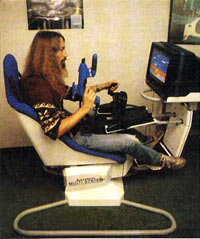
The Konix Slipstream game system is also talked about, with EGM being extremely (and rightfully so) skeptical of it's chances.  The unusual choice of chip, the hydraulic chair pipe dream, relatively high price and lack of support from A list console developers (relying almost exclusively on partnerships with computer game makers like Epyx, MicroProse, Ocean and US Gold, who all had pretty bad track records when it came to console games, pretty much meant this was a doomed project... and it was.

And in a very interesting twist, Mattel officially turned down the rights to distribute the PC Engine (Turbo Grafx 16) in the U.S. in exchange for launching their own game peripheral for the NES: The PowerGlove!!  Oh, yeah, great choice Mattel... there went the only chance we had of ever seeing a The New Adventures of He-Man game for the TG16!

Also there's a "Batman" movie coming out and some NES clones may be hitting the US market.

Previews:
While a bunch of games are previewed in short tidbits (most notably, Duck Tales which is described as appealing to a "younger audience, girls and family play") the big preview is a multi-page run down of everything known about the new 16 bit systems, starting on page 30.  PC Engine, Mega-Drive, Super Famicom, Epyx's mysterious color hand-held and Konix are all discussed at length.  A fascinating read, given what we know today about the outcome of the 16 Bit wars, and I have to give them credit for identifying the potential problems of the systems right up front.


Reviews:
A good variety of games get reviewed in this issue, including 1943, Ultima Exodus and Bubble Bobble,  for NES, Y's  and Rastan for SMS, Hat Trick for the Atari 7800, F-19 Stealth Fighter and Zak McKracken for DOS and Hybris for Amiga.  


Now, I was never really a huge fan of the EGM review philosophy that seemed to be a bit too lenient for my taste.  This tradition apparently started early and is in full evidence in this first issue.  While they seem to have stuck to fairly good games that would be hard to criticize too much, even the flaws of these titles get pretty glossed over.

Tengen's unlicensed NES port of Tetris gets the Game of the Month award.  The test includes a brief run down of the origin of the game and the original developers, as well as discussing the worldwide phenomena of the game.  A well done piece.


But then it happens... on page 58 we get a review of Double Dragon for the Commodore 64.  Now this port is universally reviled as being utter cack.  EGM finds though that "the whole package looks great".  Now they admit to a few flaws, such as "the complete lack of background music or sound effects."  Granted there is punching and hitting sounds.  They call the play mechanic "too regimented" with it's limit of only two badguys on screen at a time.  The fact that almost all the sprites are just color swipes of the player sprite, that the bosses are the same size as the player, the fact that all the holds and throw moves are missing (the EGM review says "you can also perform all of the fighting maneuvers that were found in the coin-op version, including punches, kicks, head-butts, and flying jumps") and the translucent belt line separating legs from torsos are omitted from the review.  This is either them sucking up to a manufacturer, not knowing squat about games, or just being complete tools.  

Ok... I think I have to put this into context.  Right before this review, Tradewest released Double Dragon on the NES and it was a one player only affair (similar to Final Fight on the SNES years later).  That shock was still in their bones, and the final caption on the review reveals what the reviewer meant I think: "I was immediately relieved when I read through the documentation and found that Double Dragon did indeed have the option for two player simultaneous play.  After Tradewest produced a very good one player version of Double Dragon for the Nintendo, I held a lot of hope for the two player computer translation.  While the game does capture a lot of the fun from the arcade, most of the spontaneity and surprise are unfortunately missing.  None-the-less, a good translation of an incredible coin-op game..."  
I like to think of this as meaning:  We are used to s#!§, and this is more s#!§, but at least I can suffer through this s#!§ with a buddy.  Mozeltov!

Ads:
The magazine starts with a two page spread advertising Tengen's non-licensed NES carts.  While the games themselves aren't all that impressive (mainly much older ports of Atari owned arcade properties), but Tetris is in that list, so you gotta love it.  Atari:  Holding out against business models that wouldn't end with an industry-wide collapse!


FCI advertises their "phone hotline" so you can get solutions to all your favorite NES games, like Lunar Pool and Zanac!  (yeah... I don't see this being a great revenue source...)

RoboWarrior! (I don't care what the game is like, I just frickin' love airbrush overkill!)

And is that a laser gun or the world's most smokin' sci-fi guitar?!?  or BOTH!?!?!

Taxan has a whole "Premiere Issue!!!" of their Taxan Videodiction magazine.  It's "the complete guide to Taxan games."  And which games are they?  How videodicted will we be to them?!  Why who doesn't love Star Soldier, Mappy-Land and Fist of the North Star (which given that the anime hadn't been released in the U.S., and the guy's name is Ken the Fist, a fact they even have to make fun of, this is a pointless release)!  And don't forget Mystery Quest that looks like Strawberry Shortcake lost in Bahgdad.
So yes, four page infomercials in the middle of a magazine.  AWESOME SAUCE!!!


Finally, Sega has two nice SMS ads, one for Phantasy Star (pretty audacious move to put a female character center stage) and Thunder Blade.  The really fun part with these ads is that under the Sega logo it says "From Tonka".  I had forgotten that they had the distribution rights at the time, a fact that no doubt did not help with their market share.


Conclusion:

An interesting time of change in the market, illustrated by a new magazine without much competition on the market at the time (Gamepro launched the same year, with Nintendo Power hitting the market the previous year).  Unlike European markets where the '84 crash didn't kill the world of gaming, the USA was just recovering at the tail end of the 80's and for better or for worse, EGM would set the tone of the new world of game journalism... and in that world, C64 Double Dragon was a HIT!

Friday, 16 May 2014

Retro Review of the Week: TEENAGE MUTANT NINJA TURTLES: THE HYPERSTONE HEIST


US Genesis Cover
Review by ThoRn (@RetroGameRevive)


DEVELOPER:  Konami
PUBLISHER:  Konami
PLATFORM:  Mega Drive / Genesis
                        YEAR:  1992
                        MODE:  Single & 2 Player Co-op
                        TYPE:  Beat ‘em Up

It’s 1991 and arcades all over the world are filled with the sound of coins being dropped in to machines in the hope that each credit given will be the golden ticket to arcade fame & glory, being able to show off your high score on your favourite cabinet – was there any better feeling?! 

The juggernaut that was Capcom’s Street Fighter II: The World Warrior had just graced the world.  Kids, teenagers and adults were flocking to it in stampedes but just a few months later after it’s release one of Capcom’s biggest rivals, Konami unleased a machine that would embrace one of the biggest selling franchises of the time and produce what has been argued as one of the greatest beat ‘em ups of all time ‘Teenage Mutant Ninja Turtles: Turtles in Time'.

One year later Konami took this arcade king of Beat ‘em ups and released it on Nintendo’s latest console, the Super Nintendo Entertainment System.  This game was praised as being an excellent representation of the arcade hit with not only arcade quality sound and graphics; it also had extra levels that were not available in the arcade.  It was a true masterpiece. But what about SEGA?  All of the Mega Drive and Genesis owners were missing out.  Or were they…….?

Enter The Hyperstone Heist.
                                         
US Title screen

Story
Shredder has stolen the powerful Hyperstone to shrink New York City and it's up to you to teach that treacherous troublemaker not to mess with the fearsome foursome!  Pulverize shrink-happy Shredder before he pockets the whole planet!

Game Play
When playing ‘The Hyperstone Heist’ at first glance it’s not hard to look at it as an inferior version of ‘Turtles in Time’ but that’s where many people have made their first mistake.

Although there is no denying it has been cloned from ‘Turtles in Time’  the game has been rearranged with just enough subtlety that it should be looked and played as it’s own game in it’s own right.  One of the things that set this game apart from its SNES competitor is the length of each level and the difficulty.  Granted there are only five stages in Hyperstone Heist, but each level is considerably longer and enemies move much faster and are far more antagonistic which helps create a different play style mechanic players would have been used to from Turtles in Time. 
Down in the sewers underneath New York City

Personally I see this is a good thing as it allows the player to immerse themselves just that little bit further in to each level without it seeming repetitive with mindless button mashing.  Konami have also added in a few exclusive for the Mega Drive / Genesis version like a boss battle against Shredders 2nd in charge & ‘Go to man’ Tatsu who has made appearances in the first two original TMNT movies but has never been featured in an arcade or console TMNT game.  The only other Tatsu appearance was in ‘Manhattan Missions’ for PC DOS in 1991.  There are also exclusive levels either brand new direct for the Mega Drive or updated levels from the original TMNT Arcade game that fit seamlessly in to the Hyperstone Heist story and game play.

Walking the street of New York taking on 'The Foot'
This game has a great learning curve which really helps you enjoy and get the most out of it.  As you start the game you are down in the New York sewers and although the ‘Foot’ will come at you immediately they don’t overwhelm you and it just feels like a steady but strong way to start a game.  Before you know it, you are up in the streets of New York being consumed by armies of ‘Foot’ but because you have had the time to adjust you are ready to take them on without even thinking twice about it.

Every now and then a game series comes along and as soon as you hear the name you automatically think of something specific to that game: Mortal Kombat had the violence, Castlevania had candle whipping and Teenage Mutant Ninja Turtles had……  SURFING!  And in true tradition there is a great surfing scene in 'Hyperstone Heist'.  In fact the surfing scene tends to make more sense in 'Hyperstone Heist' as it’s actually done in open water and leads up to the next part of the stage which is the boarding of ‘The Mysterious Ghost Ship’ where ‘Sewer Surfin’ (as fun as it is) in 'Turtles in Time' does not really lead to anything relatable after you defeat the Rat King as it leads in to the Technodrome.  It’s the small details like this that help Hyperstone Heist Break away from the 'Turtles in Time' mould and really show how it can be viewed as it’s own game.

Surfin' Turtles

Graphics & Sound
Despite the colour palette limitations of the Mega Drive, this is an extremely bright and vibrant game.  Konami have always made the most of the Mega Drives hardware and this game is no exception. 

Even though this game does lack some graphical detail compared to the SNES it makes up for it with more background layers, Parallax scrolling and much smoother animation for each character.  It also feels to run a little quicker too, but that must be the result of SEGA Blast Processing Power.

Showing Krang who's BOSS!
The game has some great music scores and like all Konami games there is a sound and music test so you can enjoy all the tunes until your heart is content.  The game does tend to lack quite severely in the sound effects.  You can definitely tell what hardware it’s running on when you hear the tinny sound of the Mega Drives sound chips come through when you attack your enemy.  But I found it’s an issue that tends to leave you as you become more immersed in the game.
The Final Shellshock against Shredder


Controls
The controls are almost identical to the arcade and SNES version with the exception of a dash button now added.  Although you still have to ability to pick up and slam enemies you can no longer throw them at the screen.  However, you still have your ‘power attack’ function which unleashes larger amounts of damage to your enemy but at the cost of losing some of your own health bar.

                                     
Overall
It is unfortunate this game was over shadowed by ‘Turtles in Time’ as it is a fantastic beat ‘em up and offers some great features and game play. 

The 2 player co-op is everything you want it to be just like you should expect from an arcade style beat ‘em up but single player can be just as much fun.

 To enjoy this game to its full potential it’s very important to treat it as its own game and not the inferior port most people see it as.  If you are willing to do that, it will be a great experience and you won’t regret the time spent playing it.

Verdict: 4 out of 5 stars


Pick your favourite Turtle and 'Kick some Shell'