We are a collection of retro gaming enthusiasts who, on a monthly basis, select and collectively play an old game. Feel free to browse our blog posts, gameplay videos etc., and if some of it sparks your interest, consider joining us in our gaming endeavours! We hang out in the forums of the excellent retro gaming podcast Retro Game Squad, so come join us and have fun playing and discussing some retro classics!
Looney Tunes Collector: Alert! Platform: Gameboy Color Release: 2000 Developer: Infogrames Lyon Publisher: Infogrames Designer: Vanna Ty Animator: Lionel Frappé Graphics: Josiane Girard Programmers: Séphane Abrassart, Laurent Krzywanski, Alexander Bacquart, Sébastien Charvet, Florent Curé Composer: Alberto José González
In June 2000 the handheld game market was still clearly dominated by only one player: Nintendo. The Gameboy Color had brought new life to the aging Gameboy handheld market and the true successor, the GBA was still a year away from North American shelves, with competitors like the Neo Geo Pocket and cellphones making little to no impression.
With hardware limitations in the age of 3D graphics on consoles making development of new ideas harder and harder on the handheld, a slew of clones of successful games were hitting the market, and nothing was more successful than the all-powerful Pokemon franchise. Looney Tunes Collector: Alert! (aka Looney Tunes Collector: Martian Quest in Japan, Attacke von Mars in Germany, Gevaar van Mars in Holland and Martian Alert elsewhere in Europe) was originally perceived to be just another Pokemon retread with a famous license thrown on top, and if you heard the pitch, that's what you'd think.
The plot revolves around Bugs Bunny, once again taking a wrong turn at Cocomo and overhearing Marvin the Martian's plan for destroying the earth. Naturally you have to stop him by collecting the pieces to his teleportation device and to do so must "collect" various Looney Tunes characters. Said characters can then be traded with friends using the link cable.
Sounds pretty much like Pokemon right? Thankfully nothing could be further from the truth.
The game owes more to The Lost Vikings than to Nintendo's Gotta-Catch-Em-All addiction machine. The main game is played from a forced perspective angle (think overland map in Zelda), with a variety of jump and run elements as well as some combat (Alladin on Genesis is a good parallel for the feel, only with screen depth). As you progress several obstacles (Martian creatures, hunters, etc.) will block your path, as well as the afore mentioned Looney Tunes. As you defeat them or perform tasks for them, they will join your quest and by switching between characters new abilities are unlocked. Speedy Gonzalez can run really fast and enter small mouse holes, Tweety can fly over long gaps, Daffy can swim, etc.) This combination of elements gives the game a strong puzzle element and feels very Metroidvania-ish. The fun little dialogue sequences (that aren't brilliant but do let you harken back to classic toons) and the spot on graphics that are surprisingly well realized and animated, especially given the system limitations, make Looney Tunes Collector a brilliant and fun game.
The next year a sequel came out (further deepening the Pokemon-a-like image) called Looney Tunes Collector: Marvin Strikes Back! (Martian Revenge! in Europe). The same game engine is employed here and characters could be transferred between the two games, but this time you take on the role of Marvin the Martian. The plot is a fun twist (Marvin is ticked off at being defeated and decides to take it out on Daffy who has gone on TV to claim credit for Bugs' deeds in the first game). While adding nothing truly new, it was more of a great game that should also be enjoyed.
Magazine: Electronic Gaming Monthly Cover Date: May 1989 Country of Origin: USA
We kick off the ReMEMBeR series here at Retro Gaming Club with a seminal classic of the game industry, celebrating 25 years since first being published in 1989, Electronic Gaming Monthly #1.
First a bit of history about this publication: The brainchild of Steve Harris, a high school drop out, who funded the publication with winnings from the Video Games Master Tournament, EGM would go on to be a seminal publication in the American Video Game landscape. The original four issues and buyer's guide that preceded this first issue were no major successes but were enough to garner him enough funding to launch the May 1989 issue. While the magazine finally closed its doors in 2009, it will long be remembered as an accessible gateway for many people first entering the gaming market.
News:
So what was on the minds of gamers in May 1989?
Nintendo starts leaking rumors about a portable game console with a built in screen! The pricing estimate of $70 for the unit and $20 for games is compared with the considerably more expensive Vectrex from 6 years earlier (the Gameboy ended up launching in the U.S. for $89.99 in July, 1989). The question of whether hand- helds would eclipse the home console market is postured, an interesting bit of deep thought going on there, which we all know wouldn't happen until 2024 when the Nintendo DB (Direct-to-Brain) would take the world by storm and allow us all the live in a skinned over reality resembling the Mushroom kingdom. :)
A California company called Eclectic Products begins offering an arcade style cabinet that can house an NES. A sleek bit of kit for those looking to play like in an arcade.
Williams Electronics (described as a member of the "dying breed" of U.S. game manufacturers) announced N.A.R.C., touting the digitized graphics and some hard core violence. The most interesting bit is how the game is costing "up-wards of half a million dollars!" to develop. Man, how development has changed... Cinemaware announces deals to port their games to the NES, through Ultra Games (a subsidiary of Konami, started to by-pass Nintendo's restrictions on the number of titles a company could release each year) and Activision. It is interesting to note that Cinemaware didn't sign any kind of exclusive deal for the ports and also that EGM see's the merging of console and computer gaming as a "new field". While the news section is interesting, the real "news" is page 22's Gaming Gossip! This is where the magazine gets interesting for the historical geeks.
The lead story is the Tengen (aka Atari) vs. Nintendo legal suit over whether or not developers can make unlicensed carts for the NES. Of course the anti-trust suit was settled out of court, but is a fun bit of history. They also talk about Microprose developing a flight sim for arcades "that is supposedly powered by a new technology that can paint realistic characters that are so detailed, the planes you may be fighting in future coin-op contests will streak by with such clarity that you'll see the rivets on the wings!" This is followed by a line on how Atari may have beaten them to the punch with "similar technology" in their Hard Drivin' game. Are they talking about filled polygons?!?
I think they are!
Ultima V is being ported to the Sega Master System and will have a battery back up that will hold for FIVE years!!! And there's this movie called the Abyss coming out by the Aliens and Terminator guy... they expect it to be a big action set piece apparently....
Hasbro cancels the NEMO, the FMV/gaming hybrid system. The launch titles for the system, such as Night Trap and Sewer Shark, would re-emerge years later as Sega-CD titles.
The Mega-Drive's launch in Japan is recapped, noting the less than spectacular graphics on the launch titles and a special mention to the sound. Apparently the delay of the Super Famicom is being chalked up to the NES market being so robust and a lack of software being ready for the new machine. Not sure if this was true or they just weren't ready with the hardware yet and spinning it to make it look like they weren't behind the times. They are talking about a Sept. 1989 launch in Japan, which wouldn't actually take place until Nov. 1990. An interesting first image of the Super Famicom (with its six button pad) appears later in the mag.
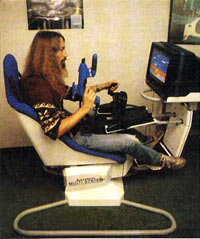
The Konix Slipstream game system is also talked about, with EGM being extremely (and rightfully so) skeptical of it's chances. The unusual choice of chip, the hydraulic chair pipe dream, relatively high price and lack of support from A list console developers (relying almost exclusively on partnerships with computer game makers like Epyx, MicroProse, Ocean and US Gold, who all had pretty bad track records when it came to console games, pretty much meant this was a doomed project... and it was. And in a very interesting twist, Mattel officially turned down the rights to distribute the PC Engine (Turbo Grafx 16) in the U.S. in exchange for launching their own game peripheral for the NES: The PowerGlove!! Oh, yeah, great choice Mattel... there went the only chance we had of ever seeing a The New Adventures of He-Man game for the TG16! Also there's a "Batman" movie coming out and some NES clones may be hitting the US market.
Previews: While a bunch of games are previewed in short tidbits (most notably, Duck Tales which is described as appealing to a "younger audience, girls and family play") the big preview is a multi-page run down of everything known about the new 16 bit systems, starting on page 30. PC Engine, Mega-Drive, Super Famicom, Epyx's mysterious color hand-held and Konix are all discussed at length. A fascinating read, given what we know today about the outcome of the 16 Bit wars, and I have to give them credit for identifying the potential problems of the systems right up front.
Reviews: A good variety of games get reviewed in this issue, including 1943, Ultima Exodus and Bubble Bobble, for NES, Y's and Rastan for SMS, Hat Trick for the Atari 7800, F-19 Stealth Fighter and Zak McKracken for DOS and Hybris for Amiga.
Now, I was never really a huge fan of the EGM review philosophy that seemed to be a bit too lenient for my taste. This tradition apparently started early and is in full evidence in this first issue. While they seem to have stuck to fairly good games that would be hard to criticize too much, even the flaws of these titles get pretty glossed over.
Tengen's unlicensed NES port of Tetris gets the Game of the Month award. The test includes a brief run down of the origin of the game and the original developers, as well as discussing the worldwide phenomena of the game. A well done piece. But then it happens... on page 58 we get a review of Double Dragon for the Commodore 64. Now this port is universally reviled as being utter cack. EGM finds though that "the whole package looks great". Now they admit to a few flaws, such as "the complete lack of background music or sound effects." Granted there is punching and hitting sounds. They call the play mechanic "too regimented" with it's limit of only two badguys on screen at a time. The fact that almost all the sprites are just color swipes of the player sprite, that the bosses are the same size as the player, the fact that all the holds and throw moves are missing (the EGM review says "you can also perform all of the fighting maneuvers that were found in the coin-op version, including punches, kicks, head-butts, and flying jumps") and the translucent belt line separating legs from torsos are omitted from the review. This is either them sucking up to a manufacturer, not knowing squat about games, or just being complete tools.
Ok... I think I have to put this into context. Right before this review, Tradewest released Double Dragon on the NES and it was a one player only affair (similar to Final Fight on the SNES years later). That shock was still in their bones, and the final caption on the review reveals what the reviewer meant I think: "I was immediately relieved when I read through the documentation and found that Double Dragon did indeed have the option for two player simultaneous play. After Tradewest produced a very good one player version of Double Dragon for the Nintendo, I held a lot of hope for the two player computer translation. While the game does capture a lot of the fun from the arcade, most of the spontaneity and surprise are unfortunately missing. None-the-less, a good translation of an incredible coin-op game..." I like to think of this as meaning: We are used to s#!§, and this is more s#!§, but at least I can suffer through this s#!§ with a buddy. Mozeltov!
Ads: The magazine starts with a two page spread advertising Tengen's non-licensed NES carts. While the games themselves aren't all that impressive (mainly much older ports of Atari owned arcade properties), but Tetris is in that list, so you gotta love it. Atari: Holding out against business models that wouldn't end with an industry-wide collapse!
FCI advertises their "phone hotline" so you can get solutions to all your favorite NES games, like Lunar Pool and Zanac! (yeah... I don't see this being a great revenue source...)
RoboWarrior! (I don't care what the game is like, I just frickin' love airbrush overkill!)
And is that a laser gun or the world's most smokin' sci-fi guitar?!? or BOTH!?!?!
Taxan has a whole "Premiere Issue!!!" of their Taxan Videodiction magazine. It's "the complete guide to Taxan games." And which games are they? How videodicted will we be to them?! Why who doesn't love Star Soldier, Mappy-Land and Fist of the North Star (which given that the anime hadn't been released in the U.S., and the guy's name is Ken the Fist, a fact they even have to make fun of, this is a pointless release)! And don't forget Mystery Quest that looks like Strawberry Shortcake lost in Bahgdad. So yes, four page infomercials in the middle of a magazine. AWESOME SAUCE!!! Finally, Sega has two nice SMS ads, one for Phantasy Star (pretty audacious move to put a female character center stage) and Thunder Blade. The really fun part with these ads is that under the Sega logo it says "From Tonka". I had forgotten that they had the distribution rights at the time, a fact that no doubt did not help with their market share. Conclusion: An interesting time of change in the market, illustrated by a new magazine without much competition on the market at the time (Gamepro launched the same year, with Nintendo Power hitting the market the previous year). Unlike European markets where the '84 crash didn't kill the world of gaming, the USA was just recovering at the tail end of the 80's and for better or for worse, EGM would set the tone of the new world of game journalism... and in that world, C64 Double Dragon was a HIT!


 The next year a sequel came out (further deepening the Pokemon-a-like image) called Looney Tunes Collector: Marvin Strikes Back! (Martian Revenge! in Europe). The same game engine is employed here and characters could be transferred between the two games, but this time you take on the role of Marvin the Martian. The plot is a fun twist (Marvin is ticked off at being defeated and decides to take it out on Daffy who has gone on TV to claim credit for Bugs' deeds in the first game). While adding nothing truly new, it was more of a great game that should also be enjoyed.


_box.jpg)