Friday, 9 May 2014

Retro Review of the Week: R-Type

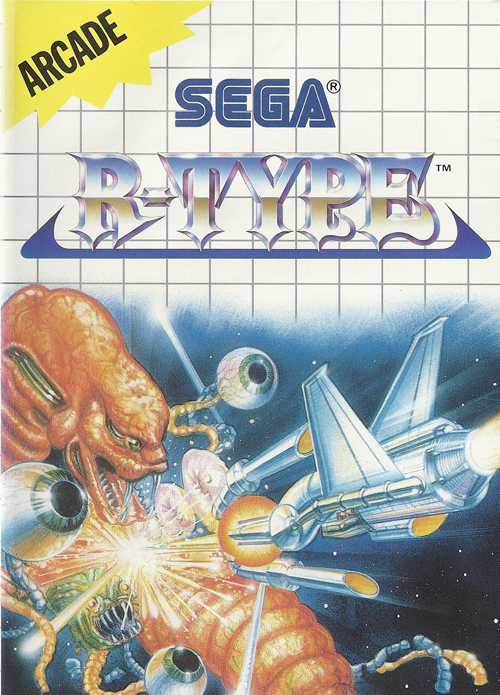
r-type_front.pngR-Type

Platform: Sega Master System
Release date: 1988
Developer: Irem, Compile
Publisher: Sega
Type: Horizontal shooter (shmup)

“They came from a dimensional plane clear across the galaxy, wreaking havoc and chaos from star system to star system. With an evil that smothers all resistance with fear and terror, the horrid creatures of the Bydo Empire are now knocking on Earth’s front door.”

R-Type is a game from the period of time where story seemed non-existent, as long as there were martians to shoot or goombas to jump on, everyone was satisfied. A wonderful time, where gameplay was king. This does not mean that the games didn’t have a story though, but instead of telling it through the game, the entire background story was most often conveyed in the manual (and often in perfect Engrish). R-Type is one of those games where you’d be excused if you didn’t know the story, but there is in fact a story: The evil creatures from the Bydo Empire are attacking Earth, and you, the pilot of the super secret aircraft R-9, the only aircraft capable of attacking the enemy in their own dimensional plane, are Earth’s last hope.


R-Type is a side scrolling shmup of the classic one-hit-means-death mold. You control the R-9 ship while flying from left to right trying to eradicate all alien lifeforms you encounter on your way. You have two firing modes on the ship’s energy weapon: tapping rapidly to fire a lot of short pulse beam shots, or holding the button to build up energy and release a massive laser blast. Switching between these modes is vital to doing well in the game. Apart from the main weapon you can pick up “droid units” that are dropped by certain enemies when you shoot them. The droid unit augment your ship’s firing power and can be used either attached to the front or rear of your ship, or you can let it roam freely around you and shoot whenever your ship shoots. The game also has multiple power-ups that you can pick up ranging from reflecting laser beams and guided missiles, to pulse beam shooting “power spheres”. As you pick up these your ship becomes increasingly powerful, and you feel like a true badass when sporting this impressive weaponry, but don’t get too comfortable! One single misstep, one enemy bullet grazing your ship’s hull, and you are done - and when you come back in a new ship all your weapons are gone.


R-Type is a hard game to pin down. Initially I approached it as a classical shooter, expecting that I, after learning the enemy movement patterns, would be able to shoot all enemies on screen, but I quickly found out that that was a big mistake. While I wouldn’t describe R-Type as a “bullet hell” shooter, it does help to approach it as one. Don’t worry about the enemies, simply try to stay alive while shooting as many of them as you can. And hang in there! This game may feel extremely hard in the beginning, but if you give it just an hour or so you will soon learn to navigate the first couple of stages.


R-Type was initially an arcade game developed by Irem, and being an arcadeoholic I’d of course recommend the arcade version, but the Sega Master System port, done by Compile, is really an excellent conversion. It is an impressive port when considering the limited power of the Master System console, so I’d recommend this version any day.

Verdict: 4 of 5 stars

How to pick it up: R-Type for the Sega Master System used to be available on the Wii virtual console, but for some reason (probably licensing issues) it was removed from the store. So if you want to try out this gem of a game, you need to go find yourself a physical copy somewhere. It’s a quite common cart so it shouldn’t be too expensive.

Monday, 5 May 2014

Game for May 2014: Trouble Shooter (Genesis/MegaDrive)


This month's RGC game is Trouble Shooter.

A Genesis exclusive, Trouble Shooter was released in 1991 (at the dawn of the Genesis/SNES rivalry). In it's native Japan it was known as Battle Mania and was developed by Vic Tokai.

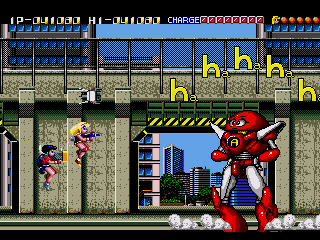
The plot of Trouble Shooter is a tongue in cheek take on the save the princess concept, with the player taking on the role of a duo of teenage girl super mercenaries in a scifi setting heading out to rescue a prince before his abduction can cause a major international incident.

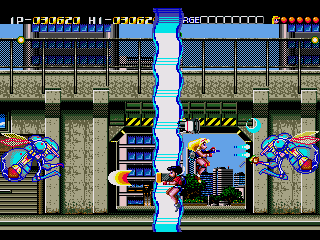
Gameplaywise Trouble Shooter is a quirky side Scrolling shooter that is visually inspired by teenage school girl anime shows and combines elements from R-Type and other Action games. The most unique aspect of the game mechanic is that we control a duo of teenage super mercenaries. The second of which (the side kick, who is also imune from hits) can be switched between firing backwards and forwards. In addition to the two way shooting mechanic, there is also a special move accessory which the player can choose from a selection of available options at the beginning of each level.


The enemy waves are varied and the action clear. Some critiques of the game at the time of its release concentrated largely on the lack of a multiplayer mode and the relatively slow turn around time of your companion. The game also only gives the player one life (with a set number of hits that can be taken) and no continues. Despite this the game got positive reviews, being a well designed and entertaining shooter.

Vic Tokai was a bit of an unusual developer that felt almost like a pre-crash fly by nighter, being the subsidiary of a major telecom company. This "cash-in" feel lead to a variety of games being developed on a plethora of platforms ranging from the C64 to the N64, without any Major concentration developing on a single system. This did not mean they produced bad games though, giving us high water marks like The Mafat Conspiracy, The Gene Machine and Shinobi Legions. But there were also some serious turds in the pile as well (Aero Fighters on N64 and Top Gear 2 on CD32 come to mind).


Trouble Shooter did get a sequel, that never made it to the USA or Europe. In it there were some clear references to the developer's less than positive views of Nintendo and the SNES, making the game a bit of a cult classic for the Genesis community.


Monday, 28 April 2014

Retro Review of the Week: Bill and Ted's Excellent Gameboy Adventure


Bill and Ted's Excellent Gameboy Adventure
Developer : Beam Software
Publisher  : LJN Software
Platform   : Gameboy
Release   : 1991 (EU, NA)
Designer  : James A. Dorsman, 
                 Mark Buda, Eric Harlow 
                 and Richard Lamb.
Composer: James A. Dorsman
                 and Douglas E. Mackall


This is a game that often gets completely ignored by gamers, this is probably due to the lack-lustre graphics and the fact that people naturally assume its a conversion of all the terrible Bill and Ted Games released on the NES, Atari Lynx or Home Computers.  Thankfully this game is completely different to those lack lustre games and instead is a highly addictive single screen platform game, reminiscent of the 8-bit classic Chuckie Egg or Epyx's Jump Man and Manic Miner.


The purpose of the game couldn't be simpler. The evil DeNomolos want's to change the future and so it is down to both Bill and Ted to jump their way through 50 levels collecting all the lost time fragments and thwart his most totally heinous plan. 

What I love about the game is the games simplicity and solid controls. Also each level offers a totally new platform element or puzzle to overcome, making each new level genuinely fresh and new, a joy to discover that drives you onwards through all the levels. Combine that with ten worlds to explore and nicely laid out password system and there is just the right balance of platform challenge, only sometimes dipping over into being overly frustrating. For me it is platform gaming at its purest form and all the better for it. 

The two player option is a nice touch, you can't play simultaneously, but by taking it turns, which adds a nice competitive edge to the game as both players tries to out do each other.


All in all a top game, that is well worth play, especially if you loved your Chuckie Egg and Manic Miner games back in the day and are looking for a game that takes what made those games great and running with it. So if you love your platform games, then give this hidden Gameboy gem a go. You won't be disappointed.

Verdict 4 out of 5 stars


Who is Beam Software?

Beam Software was formally known as Melbourne House, and finally Krome Studios Melborne before sadly finally closed its doors in 2010.  But during its time as a developer, they have produced some amazing games in their long career.  They were the team behind the famous ZX81 Spectrum mascot Horace in Horace goes Skiing and Horace and the Spiders,  the stunningly good Hobbit Adventure game and Way of the Exploding fist.  They also would have success with Shadow Run on the SNES and  Looney Tunes : Space Race on both the Dreamcast and Playstation 2.

Saturday, 26 April 2014

Retro Review of the Week: Project Firestart

Project Firestart
 
Platform: Commodore 64
Release: 1989 (EU, NA)
Developer: Dynamix
Publisher: Electronic Arts
Designer: Jeffrey Tunnell, Damon Slye
Composer: Alan McKean

Project Firestart was a gaming revolution upon its release in 1989.  Set on the research ship Prometheus, a massive four story behemoth, orbiting one of Saturn's moons, the game gave us, the players, our first real taste of the survival horror genre, from atmospheric cut scenes, a mysterious storyline revealed through log books, documents and dialogue sequences, the pulse pounding fear of running out of ammo, having to find scarce medical kits, discovering a massive, free roaming locale that should be populated but is eerily desolate and of course slow moving, almost invincible enemies closing in on you.  In a time when arcade action games, turn based role playing games and point and click adventure games had each carved out their own niches  in the gaming industry, becoming almost monolithic genres with almost no overlap, Dynamix broke out of the mold and created a believable open world with seemingly limitless methods of interacting with it... and it ran on a system with just 64k of RAM.


The plot of Project Firestart revolves around the attempt by Jon Hawking (our protagonist), a special forces op in the year 2061, to board the Prometheus, a space based genetic research facility, currently in orbit around Titan, discover what the cause of their radio silence is, whether or not the research can still be salvaged and in a worse case scenario destroy the ship via a remote detonator.  Of course once you arrive, the worst fears are realized and the clock is ticking.  You must find the research logs, set the bombs and get out before the government's missile strike beats you to it (with you still on board). 

The game is shown through a combination of left and right scrolling corridor segments and 3/4 view isometric room segments.  The entire ship is discoverable and includes your typical scifi labs, armory and control rooms, but adds to the atmosphere by showing the crew quarters, recreation areas, gigantic observation decks and even a video arcade.  Many mundane items throughout the game can be used, and there are often multiple solutions to problems.  The genetically manipulated creatures that have run amok (oh yeah... spoiler alert!) can be killed with laser rifles (although you'll be needing a LOT of shots to take one down and ammo is limited), or maybe the radiation from the nuclear reactor may be helpful?  How about rigging that gas bottle together with the laser gate to improvise a bomb?  The options are many and figuring out what can and can't be done, while the aliens are breathing down your neck will be a nailbiting experience.

The story is revealed through log tapes and emails accessed on a variety of computers, as well as through conversations with the lone survivor on board, a female scientist in a stasis pod.  What happened on board?  What other threats lurk in the silent corridors? 


The music is dynamic and will shift when danger nears or victory is achieved.  The various twists during the story will keep you guessing as to what could possibly happen next and the pacing seems almost cinematic.  The graphics are rotoscoped, similar to those in Prince of Persia and add an extra layer of realism to the experience.

So why haven't you heard of this game?  Why did it not usher in a new gaming revolution long before Resident Evil and co.?  There are many reasons, not insignificantly the four disk sides it came delivered on, which made it a bit of a slog at times due to loading, but the main one was the failure of the Amiga platform in the USA.  Trip Hawkins, then CEO of EA, had heavily bet on the Amiga as the future of home computing, releasing a myriad of games and applications for the system in it's first few years.  When the system failed to take off in North America (even though it did phenomenally in Europe), EA pulled most of its support and instead refocused on the 8 bit computers (Apple II and C64) that had been the company's bread and butter, as well as the increasingly important console market.  Project Firestart was thus developed for the 1983 released C64, as opposed to its 16 bit big brother.  This meant that it would be one of the last big hurrah's for the 8 bit computer scene in the USA.  C64 owners embraced the game for the gem that it was (it also had unique features like being able to save wherever you wanted and a small inventory), but with that user group growing smaller every day, and no plans for ports to other systems, it remained an insider tip as opposed to an industry sensation. 

Dynamix left EA after completing Project Firestart and moved to Sierra and began making 3D action games like Stellar 7, Nova 9, Red Baron and A10 Tank Killer and non-real time adventure games like Rise of the Dragon, Heart of China and Willy Beamish.  EA for its part would refocus for the first few years of the 90's on sports titles for consoles with only the ocassional computer release (Madden and Fifa, Centurion Defender of Rome and Birds of Prey) being stand out games that were developed in house (the acquisition of companies such as Bullfrog and Origin would of course keep the PC game output flowing).

Project Firestart is a gem of a game, that will keep you on the edge of your seat.  The story is deep without ever getting boring or monotonous.  Every action feels necessary and you will develop a Pavlovian response to McKean's danger music. 

Verdict 5 out of 5 stars


Here's further reading on the history of the game: http://www.hardcoregaming101.net/firestart/firestart.htm
And here is the C64 Wiki entry, including tips, controls, a map and a lot of animated gifs that also reveal the ending of the game (if you want full spoilage): http://c64-wiki.com/index.php/Project_Firestart

Friday, 25 April 2014

Vote for game of the month, May 2014

This month Trantor has selected six games for us to choose from. The topic of the month is action games that have a female protagonist. Trantor has come up with an excellent selection of games if you ask me, so I'll be excited to see what you guys end up voting for.

The games are:
1) Athena (NES)
Port of the SNK arcade game of the same name. A side scrolling action game with a very loose greek mythology background. Athena has been ported for a number of platforms, personally I loved the Commodore 64 version. http://en.wikipedia.org/wiki/Athena_(video_game)

2) Psychic World (Game Gear and Master System)
Side scrolling action game set in a sci-fi world with psychic powers that are upgraded as the game progresses. http://en.wikipedia.org/wiki/Psychic_World

3) Trouble Shooter (Sega Mega Drive / Genesis)
Sci-fi action side scroller with a twist on the old "valiant warrior saves the princess" theme. Here you are the female warrior saving the prince. http://en.wikipedia.org/wiki/Trouble_Shooter

4) Alisia Dragoon (Genesis)
Fantasy side scroller with the primary weapon being "thunder magic". http://en.wikipedia.org/wiki/Alisia_Dragoon

5) Pocky & Rocky (SNES)
This one is a vertical scrolling shoot 'em up (on foot like in Commando or Gunsmoke) featuring a young girl and her racoon sidekick... looks to be heavy on japanese mythological themes. http://en.wikipedia.org/wiki/Pocky_%26_Rocky

6) The Misadventures of Tron Bonne (PlayStation)
This game is a spin off from the Megaman series and features Tron Bonne (best known for her appearances in the Marvel vs. Capcom games). It's an over the shoulder 3D action game. http://en.wikipedia.org/wiki/The_Misadventures_of_Tron_Bonne

If you want to vote on which game we should play - or even better, if you want to play along with us - go to http://www.retrogamesquad.com/community/, create an account, and cast your vote in the "RGS: Retro Gaming Club"-forum. You can also vote by leaving a comment to this post.

Friday, 18 April 2014

Retro Review of the Week: Psycho Fox

Psycho Fox

Platform: Sega Master System
Release: 1989 (EU, NA)
Developer: Vic Tokai
Publisher: Sega
Composers: Fumioto Tamayama, Hiroto Kanno
Type: Side scrolling platformer

Psycho Fox is an excellent little side scrolling platformer in the vein of Super Mario Bros. You star as the fox priest Psycho Fox, who has been chosen to stop the evil Madfox Daimyojin from taking over the world. As with many of these games, the plot is of no matter though. You’ll find yourself running, jumping, and punching your way through level after level of platforming goodness, hunting down the evil bosses that guard the way to Madfox. The game is comprised of seven zones each with three rounds, and at the end of each zone you must face a boss.

Psycho Fox may sound like any other platformer from that time. The thing that sets it apart from the others though, is the ability to change character within the game. You do not only play as Psycho Fox. If you pick up a Psycho Stick, you can use that to transform into a hippo, monkey, or tiger as well. The key to mastering Psycho Fox is understanding when to use the different forms. The hippo is strong and can break certain brick walls. It only jumps very low though, so you’ll want to switch away from it as soon as the walls have been broken. The monkey is the high jumper and can be used to reach high up places. The tiger moves faster than any of the others and is useful in areas where speed if of the essence.

Throughout the levels you will find a number of eggs containing various items such as the Psycho Sticks used for transforming, straw effigies that suck up all enemies on screen, super potions that render you invulnerable for a period of time (like the star in Super Mario Bros), and bags of money that can be used after each level in a small gambling section (a game called Amida) in order to win items or extra lives. Beware when opening the eggs! They may contain foes, so do not stand too close when you open them, and be ready with an extra punch just in case.


I found Psycho Fox to be a very entertaining title all around. The music is catchy and enjoyable, the little sound effects are very nice from the jumping sound to the lovely little skipping sound it makes when you run on water (yes, you can run on water if you run fast enough). The gameplay is solid as well, as soon as you get used to the rather slow acceleration that is, but when you get past that you’ll have no problem controlling the characters. I particularly enjoyed the fact that you had different characters with different abilities to control. I only wish that feature had been used a bit more in the game.

Verdict: 4 of 5 stars

Saturday, 5 April 2014

Super Turrican: A brief history

Turrican is a 2D series of run and gun games, originally developed by Manfred Trenz for the Commodore 64 computer. The first game in the series was released by Rainbow Arts in 1990.

The basic plot can be boiled down to "Space Marine survives attack and must destroy alien bad guy".

The game mechanic takes liberally from games like Contra and Metroid, even adding the ability to jump on top of some enemies like Mario. This is in no small part due to Trenz's love of arcade and console games, especially NES console games, which received little penetration in Europe in the 1980s and were all but impossible to develop for independently. Trenz's previous game credits included Katakis/Deuteros (a side scrolling shooter strongly influenced by R-Type and the quality of which was so good that it lead Activision, the rights holder for the official R-Type home computer ports, to hire Rainbow Arts and him to develop the C64 version of that game, after threatening to sue over the similarities between the two titles) and The Great Giana Sisters (an unabashed and very much unlicensed copy of Super Mario Bros. for the C64 that lead to threatened legal action and a recall of the game). Turrican combines many console like elements, such as the 8 way scrolling, morphing into a ball and secret areas of Metroid, with brand new ideas, like the laser whip to create a very action packed and fun game. Turrican 2 would later also add side scrolling space shooter levels to break up the games run and gun action.


While Trenz was responsible for the C64 and NES ports of Turrican, the 16 bit computer and console ports were assigned to the programming group Factor 5. The team that would later develop such games as Rogue Squadron and Indiana Jones' Greatest Adventure as well as the sound compression routines that allowed most N64 games to support speech. Factor 5 would take the reigns of the Turrican franchise, developing Turrican 3 on their own (replacing the laser whip with a bionic commando like grappling gun), as well as the SNES games Super Turrican and Super Turrican 2.

Super Turrican, released in 1993, (the game we are here for) is a mixture of game elements and level designs from Turrican 1 and 2, but executed with the artstyle of the almost simultaneously released Turrican 3 (and making it even more confusing, the cover art was taken from Turrican 2... ). the game received positive, if not extraordinary reviews at the time, having been limited by budget restrictions to a 4 Mbit cart and lacking additional game features which would have been more approrpiate for a game of its time.

The series would also see ports to the Turbografx 16, Genesis, Gameboy (reskinned to be a Universal Soldier tie in), Spectrum and Amstrad. Emulated versions of the games have also appeared on the Wii and mobile phones.

While talk of a Turrican return has floated for years and a 3D demo was shown in the mid 90s, there hasn't been any movement, and Trenz no longer owns the rights to the game.

Here is a link to a phenomenal summary of the series' evolution and entries:
https://www.youtube.com/watch?v=0e2perjkl7U