Saturday, 30 August 2014

GROW: Parasol Stars

  
Review by Mads D. Kristensen
               @madsdk
DeveloperTaito
PublisherTaito
PlatformPC-Engine/Turbografx 16
Release date1991
GenrePlatformer
Players2

The arcade platformer Bubble Bobble, developed by Taito and released in 1986, was a smash hit in the arcade, and Taito naturally saw this as an opportunity to make money and turned Bobble Bobble into a series of games. The second installment in the series was the equally excellent Rainbow Islands, released only a year after Bubble Bobble in 1987. Rainbow Islands abandoned the arena platformer style of its predecessor, opting instead for a vertical platforming experience that has you battling your way from the bottom to the top in each level. These first two games were first and foremost arcade games, but both were so successful that they were ported to a plethora of home computers and consoles. Parasol Stars is the third game in the series, but unlike its predecessors it was never released in the arcade but was developed directly for the home marked, the PC-Engine / Turbografx 16 being the platform that Taito chose to release it for, with a few ports (Amiga, Atari ST, Game Boy, and NES) done by Ocean.

I feel that Parasol Stars is the forgotten Bubble Bobble game, which is really a shame as it is a brilliant little game. Perhaps it was overshadowed by the quite similar and very successful Snow Bros, developed by Toaplan and released by Capcom in 1990 - but that's just me speculating here! Snow Bros started out in the arcade and was ported to a lot of home platforms afterwards.


Parasol Stars returns to Bobble Bobble's arena platformer roots - each level is a single screen that you have to clear of enemies to progress to the next one. Your weapon of choice is no longer bubbles, this time you are armed with an umbrella - er, or a parasol I guess :-) Using the parasol you can pick up an enemy and then hurl him at the other enemies in order to defeat them. The umbrella can also pick up water droplets that you can throw at enemies, and if you pick up enough of these droplets you can unleash a water attack similar to the one found in the water bubbles in Bubble Bobble. Some foes are too large to be picked up, so these you'll have to shoot multiple times with either water or smaller enemies.

A bit of history: In Bubble Bobble the evil Baron Von Blubba has kidnapped Bubby and Bobby's girlfriends and turned the two brothers into Bubble Dragons. Bub and Bob must then fight their way through 100 levels to finally face the boss in level 100. The boss they are facing is not Baron Von Blubba though, it's just one of his minions the "Super Drunk" that hurls bottles at you. The dragons defeat the Super Drunk, release their girlfriends from the bubbles they have been imprisoned in, and are turned back into boys. In Rainbow Islands Bubby and Bobby set out to defeat the "Boss of Shadow" responsible for the events in Bubble Bobble, and to save the Rainbow Islands in the process - the "Boss of Shadow" being a new name for Baron Von Blubba. After defeating the Baron and rescuing the inhabitants of the Rainbow Islands, Bubby and Bobby are enjoying a well earned vacation. But they don't get to rest for long, as they are called upon once again, this time to save the entire universe, as the space warrior Chaostikahn unleashes his monsters throughout the universe. With their magical parasols in hand, Bubby and Bobby set out to do some planet hopping to defeat the monsters and free the universe of this new menace.


Each planet consists of seven levels, and on the last level of each planet you will encounter a boss - the planetary guardian. These bosses cannot be defeated by normal means, so like in level 100 of Bubble Bobble you'll have to pick up a special power and use it to destroy the enemy. While the first boss fight is rather easy, the difficulty of these bosses ramps up very quickly, and you will be challenged when facing off against them. As with most video game bosses it's all about pattern recognition and quick reflexes, so hang in there and you'll soon get the hang of it!


Parasol Stars is a really great arena platformer, in the traditional cute style that Taito does so masterfully. So if you like your arena platformers, I encourage you to pick up a copy of this little gem - it gets a wholehearted recommendation from me. If you have access to the Japanese Virtual Console for Wii you can get the game there, but other than that I sadly don't know where you can get your hands on a copy of Parasol Stars.


Wednesday, 27 August 2014

Visual Guide to Amiga Games: Rainbow Islands

This week the Visual Guide to Amiga Games takes a look at one of my personal favourites: Rainbow Islands. The Amiga port of Rainbow Island was done by Andrew Braybrook, and he did a stellar job, creating an almost arcade perfect port. Hint: To fully appreciate these images, click the cogwheel in the upper right corner and choose "View Full Resolution".

Saturday, 23 August 2014

GROW: Skate or Die!

Skate or Die!

Developer(s) Electronic Arts
Konami (NES)
Publisher(s) Electronic Arts
Ultra Games (NES)
Composer(s) Rob Hubbard
Kouji Murata (NES)
Platform(s) Apple IIGS, Sinclair ZX Spectrum, C64, NES, MS-DOS, Atari ST, Amstrad CPC, Virtual Console (EU and AUS only)
Release date(s) Computers
1988
NES
1988
Virtual Console
  • PAL December 21, 2007
Genre(s) Skateboarding
Mode(s) 1 - 8 players


Ah, the 80's! Reaganomics, exercise crazes, TV-cartoon-toy-tie-ins, garishly colored clothes and the death of disco... it was a halcyon time.

Into this cultural renaissance came a new phenomenon that redefined youth transportation forever: Skateboarding!  That's right, it was like rollerskating for one legged giants with no concerns for strapping themselves to their wheels.

Skateboarding was everywhere and the then youthful company Electronic Arts decided to make a computer game harnessing all the raw energy that the sport had to offer, together with a totally cool look and feel.  And an amazing title tune by the master himself Rob Hubbard!

 
Yes, those are actual guitar samples on an 8 bit computer...

Skate or Die! was released on the Commodore 64 in 1988.


Designed by Stephen Landrum, a former Epyx employee and designer on the original Summer Games and Pit Stop II, and David Bunch, who would later go on to do  games such as NHL 95 and Freestyle, with graphics by Michael Kosaka, another Epyx veteran who had worked on the Temple of Apshai Trilogy, GI Joe, World Games and Street Sports Basketball, Skate or Die! was a multiple event sports game, the pitted players against one another as well as computer controlled opponents in five different events.

Freestyle:
The first of the two Ramp events, freestyle is a competition where with a limited number of passes back and forth on a skate ramp, the player must perform as many "cool" moves as possible, to rack up points from the judges.  Repetition leads to the same move getting less points with each iteration, and some moves are only possible after speed as been gained, making planning and preparation a very important part of the design.  Given that you only have one button on the joystick, trusty old direction-button combos are necessary and pulling off moves takes a lot of practise but is by no means impossible and in fact finally pulling them off is very rewarding.

High Jump:
Using the same backdrop as the Freestyle event, High Jump becomes a mix of violent joystick back and forth mashing and timing as you try to get as high as possible without crashing head first into the ground.

Race:
A one man downhill "race" with obstacles, shortcuts and hazards.  A fun solo event where time is everything.  The player sprite can jump, duck, roll forward, backward and there are even two control set ups, regular and goofy foot.

Jam:
A two man downhill  race, where you can battle against a human player or the computer.  The race itself is more of a battle between the racers, with added "bad ass" features like knocking down bottles, avoiding hazards through shortcuts and general punk rock destructiveness.

Joust:
Probably the most epic of the many events and the one most people have the fondest memories off.  Joust has you and an opponent human or one of three computer opponenets: Poseur Pete, Aggro' Eddie and Lester, Rodney's son.
 Taking turns "at bat" with a wooden boat paddle, the two skaters must now battle it out in an empty swimming pool, one dodging until his turn with the paddle, while the other is desperately trying to knock the crap out of his prey.
Truly epic carnage!

Ports:
The game was later ported to the Apple II, Amstrad, Spectrum and NES.  While the other computer ports were more or less successful, the NES port did gain a bit of a cult following and even lead to an NES only sequel Skate or Die! 2.

In Conclusion:
Multi-event sporting games were the bread and butter of 80s computer games (especially in the USA).  Skate or Die! added a nice layer of flair and fun to an often dry genre and opened the door for other experiments like Caveman Ugh-Lympics and Bar Games.

Today, Skate or Die! is still fun with a group, although some events like High Jump and Freestyle have lost a bit of their joy due to the limited flexibility of the controls.  But there's still nothing more fun than kicking someones butt in Joust!

Thursday, 21 August 2014

Visual Guide to Amiga Games: Super Cars

This week in the Visual Guide to Amiga Games we take a look at a classic racing game for the Amiga. This and its successor Super Cars II were by far my favourite top down racing games back in the day.
Hint: To fully appreciate these images, click the cogwheel in the upper right corner and choose "View Full Resolution".

Saturday, 16 August 2014

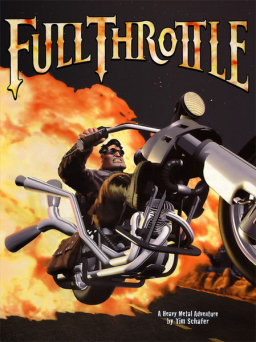
GROW: Full Throttle (PC)

Review by Clint 'Thorn' Thornton
                          @RetroGameRevive
Developer(s)LucasArts
Publisher(s)LucasArts
Designer(s)Tim Schafer
Artist(s)Peter Chan
Writer(s)Tim Schafer
Dave Grossman
Composer(s)Peter McConnell
EngineSCUMM (visual)
INSANE (cut scenes)
iMUSE (audio)
Platform(s)DOS, Mac OS, Windows
Release date(s)April 30, 1995[1]
Genre(s)Graphic adventure
Mode(s)Single-player
DistributionCD-ROM

PC games in the 90's.......  What a great time to be a PC gamer.  The variety of games might not have been quite as high of what SEGA and Nintendo were producing on their home consoles but at the same time, those purely dedicated to the Super Nintendo and Sega Genesis/Mega Drive were missing out on a whole new world and gaming experiences.  Nobody can argue that the PC was the undisputed king of 1st person shooters with such masterpieces like Doom, Duke Nukem 3D & Quake.  But the PC was also awarded champion of another genre, no home game console could compete with, The 'Point & Click' adventure game.  When I first started playing these epic adventures I was playing Sierra game series like 'Space Quest' and 'Kings Quest' but when I finally played my first LucasArts game there was no turning back for me......

.....  I had played my fair share of LucasArts adventure games before I played 'Full Throttle' and although I loved the in-depth story telling of games like Monkey Island and the crude humor that Sam & Max could offer, I found a perfect balance of everything I loved in these games in Full Throttle.

Corley & Ripburger
PLOT
You are Ben, leader of the Polecats.  An outlaw motorcycle gang in the year 2040 who own highway 9.  The game starts with an animated cut scene of the Polecats advancing on a hover-limousine driving through their territory.  Without knowing or caring who is in the limo Ben decides to ride over it, damages the vehicle and takes off down the highway.  Turns out the passenger of the limo is Malcolm Corely of Corely Motors, the last Motorcycle manufacturer in the country and one of Bens idols.  Malcolm requests his drivers to catch up to Ben and his gang and finds them having a drink at the Kick Stand Bar alongside the highway.  Malcolm  approaches Ben and asks him and the Polecats to escort him to the Annual Corley Motors shareholders meeting.  Although Ben respects Malcolm he replies 'The Polecats are not for hire" and declines the offer.  Malcolm's 2nd in charge Adrian Ripburger asks to speak to Ben privately outside and before Ben knows it he has been knocked unconscious and been tossed in a dumpster.  Ben soon finds out his gang have been lied to and could be heading straight in to trouble, so he must start his journey to uncover the truth of what is really going on and to save his motorcycle gang.
The very simple yet effective graphical interface

GAMEPLAY
The best thing about LucasArts adventure games is that they all follow a very similar protocol when it comes to the mechanics of the game.  Your mouse is all you need for most of the game with a very simple graphical interface.  You only need to choose 1 of 3 icons for interaction with each icon having multiple uses.

Fist: Use, Grab or Hit
Skull: Tongue (Speak or taste), Eyes (Examine)
Boot: Kick

Polecats vs Rottweilers - One of the 'Real Time' combat scenes

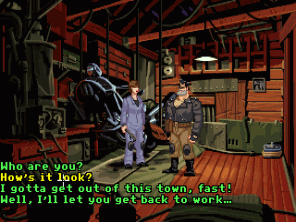
Throughout your journey you will have an inventory of tools and weapons once again all controlled very simply by the mouse.  As you go from place to place you will be required to talk to the people along the way as they will be the ones who point you in the right direction.  As you speak to these people you will be given a choice of different things to say to them but it will always be in your best interest to ask all the questions no matter how pointless they may seem at the time.
Ben doing a few favors for Maureen

Although there is no real time limit to the game you will be put in to situations that require you to think quick or make the correct decision otherwise you may end up dying.  But the good news is there is no 'Game Over' in Full Throttle so all you need to do is learn from your mistakes the next time around and you will make solid progress.  For those who have played a few LucasArts games you will notice that Full Throttle is one of the shorter adventures and the puzzles are not quite as complex as games like the Monkey Island series but I don't feel that inhibits the game from still being a fulfilling adventure.  If you haven't had much experience with 'Point & Click' adventure games but want to give them a go then I would say Full Throttle is the perfect place to start.


Highly detailed hand drawn art

GRAPHICS
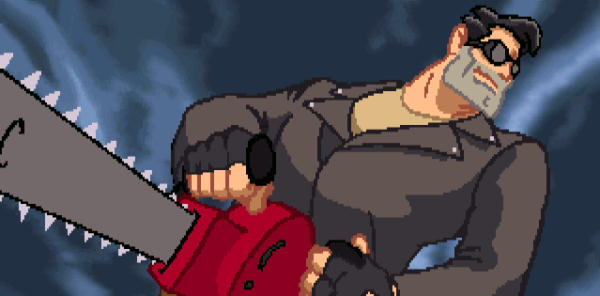
Full Throttle made full use of the SCUMM engine to produce crisp characters and highly detailed backgrounds.  The game also uses pre-rendered graphics using the INSANE engine.  You will notice this the most in the scenes when Ben is on his bike on the Old Mine Road and although the final product looks great, this was apparently very difficult to pull off for the artists as the INSANE engine was designed for photo-realistic graphics and not the cartoon style you see in the rest of the game.
The INSANE engine at work but still producing that cartoon look it was apparently not supposed to do

You just can't help but appreciate the art style
AUDIO
Full Throttle was only released on CD-ROM so you will be treated to a full voice over soundtrack using real voice actors and not just LucasArts staff that have been known to take to the mic in previous games.  Mark Hamill is the most noted voice actor of the cast and plays the perfect villain of Ripburger.  But in saying that all the voices fit each character perfectly all with well spoken dialogue.  It is also one of the few LucasArts games to use licensed music from external artists such as 'The Gone Jackals'.

OVERALL
This is definitely one of the most complete adventure gaming experiences you can have without spending hour after after trying to decode puzzles.  Some people might say it's the games weakness but I say it's perfect for what it is.  As much as we love to delve deep in to the 'Point & Click' adventure genre and put our brains to the test whilst enjoying an in-depth story to accompany it, sometimes we just want to simplify things and enjoy the game for what it is.


Tuesday, 12 August 2014

Visual Guide to Amiga Games: Rick Dangerous

After a brief hiatus, we continue the series of pages from the Visual Guide to Amiga Games. This time we take a look at the excellent but very hard action platformer Rick Dangerous. Hint: To fully appreciate these images, click the cogwheel in the upper right corner and choose "View Full Resolution".

Saturday, 9 August 2014

GROW: H.E.R.O. (Commodore 64)

Review by Mads D. Kristensen
               @madsdk
DeveloperActivision
PublisherActivision
DesignerJohn Van Ryzin
PlatformCommodore 64
Release date1984
GenrePlatformer
Players1

Volcanic activity has trapped miners in mineshafts in Mount Leone. Roderick Hero, or R. Hero (a pun on "our hero"), is sent out on a "H.E.R.O." (Helicopter Emergency Rescue Operation) to save the miners. Equipped with his helicopter backpack and a helmet capable of shooting a laser beam at any critters within the caves, he starts on his descent into the dangerous caves of Mount Leone.

The very first screen of H.E.R.O. on Commodore 64
H.E.R.O. was an important turning point in the history of the platformer. Not only did it break away from the standard mould of moving only sideways and (most often) from left to right, it also showed that running and jumping, the staple of most platformers, wasn't really necessary to make a successful game. In H.E.R.O. you mostly move downwards, making your descent into the caves looking for the lost miners, but there is some sideways movement too, and often those segments are the hardest to traverse. As for running and jumping, while Roderick is capable of running on platforms, there is really no need for jumping when you can fly, and you will be flying most of the time while traversing the caves of H.E.R.O.

1984 was a great year for platform games. Not only was H.E.R.O. released, also great classics like the extremely ambitious Jet Set Willy, follow up to the successful Manic Miner, was released the same year, as was the seminal platformer arcade game Pac-Land - the first horizontally scrolling platform game to be released. For more information about the evolution of the platformer, check out this recent US Gamer article by Jeremy Parish entitled Five Critical Moments in Platform Game History.

Traversing the caves can be tricky as they are filled with dead ends, monsters that will kill you on the first touch, and even magma flowing through some walls and floors. Finding the correct path becomes an enjoyable puzzle in itself, and you will quickly adapt your style of play to one where you cautiously explore new screens to avoid rushing into your death. The path to victory is often the one most bothersome one, so if you descent into a screen that presents you with two choices: 1) leave directly by going down the tunnel to the left, or 2) blast your way through a monsters and and wall to get to the tunnel on the right, then you can be almost certain that the second choice is the right one, and that the first one will only lead to a quick death.


Sometimes you will be flying blind, if you accidentally touch and break the lamps found in certain places of the mine. When it is dark you can still see the outlines of monsters and any exits going up or down, but there is still one way to get a look at the screen: you can drop a stick of dynamite and in the few seconds the fuse is burning you can see the entire screen. The dynamite is used to break walls, just press down on the joystick while pressing the fire button, and then hurry away to safety! If you stand to close the explosion will kill you. Walls can also be broken using the laser in your helmet, it just takes a long time, so if you have the room for a quick escape, use a stick of dynamite instead. Some walls and floors are filled with magma, so you have to take care not to get too close, or you'll die when you touch them, but they do have one nice feature to them - If you accidentally break a lamp, the magma filled parts of the stage will still be visible.


H.E.R.O. was initially developed for the Atari 2600, but was quickly ported to many other home computers and consoles of the time. I grew up with the C64 version of the game, so therefore I opted for that version when creating screenshots and video content for this article. To play H.E.R.O. today the easiest way is to pick up one of the excellent C64 emulators available and then finding a tape or disk image on the Internet - unless you, like me, have a C64 standing in your closet. Then it's about time you took it out of the closet, dusted it off, and fired up this classic game ;-)